Native Alaskans have story circles where tribes, villages, and families regularly gather for sacred remembering. It is in the context of story circles where each person is dignified for their holy image, the particular narrative they live and experience. In the telling and in the receiving of those stories, the gathered community becomes part of one another stories. They are in the realm of the Ancestors, those who are presently present and those who have gone to the Creator. It is in remembering, that we are re-membered, more knit to one another in a deeper and profound way than when before the story circle convened. This is what in our Christian tradition is called koinonia, translated “fellowship” or “communion” (1 Cor 1:9; 10:16-17), is what Filipinos call kapwa, akin to Zulus of southern Africa call ubuntu, and Latinx theologies calls en conjunto. That is to say, we belong one to another, that to understand the self it is in relation to the wider community to which one belongs. The community is not the sum of the individual parts. Rather, it is I-and-We or the I-in-We. This means there is mutuality, accountability, reciprocity. Or to put it in terms of the trifold apostolic gifts, it is the sharing and giving of faith, hope, and love. (1 Cor. 13:13)
This past Juneteenth, several of us representing Asian American and Latinx churches gathered for a 3-day retreat in Daly City, organized by New College Berkeley. Over food and table conversation in our AirBnB, we quickly connected and opened up with one another. This was an ecumenical, intergenerational gathering of pastors, theologians, and community organizers who embody and live out the Christian faith in churches, seminaries, and nonprofit organizations. We spent time analyzing the forces and factors in American culture, history, polity, and the body politic that have shaped and continue to shape our communal identities as Asian American and Latinx American Christians. We recognized the ancestry we inherit, the struggles of all those who have gone before us, and the present struggle we are engaged in for protection of and advocacy for the marginalized and vulnerable. We were mindful and heartful of the present circumstances and conditions in the United States where immigrant and migrant communities live in fear of being separated from their families, detained, or deported.
As a newcomer to New College Berkeley’s program, I observed how our gathering was in itself a countervailing, countercultural act to the white Christian nationalist spaces in which we live, and move, and have our being. Our retreat was the one space in time, a punctuation in that week for a group of God’s children of color with shared ancestry can resonate and relate with one another as to the sacred Ancestors’ struggle for equality and equity, for embodied faith that integrated our Asian American Christian and Latinx American Christian identities over and against powers and principalities – whether ecclesiastical, theological, political, socio-cultural-economic – which seeks to homogenize or totalize who we are and whose we are.
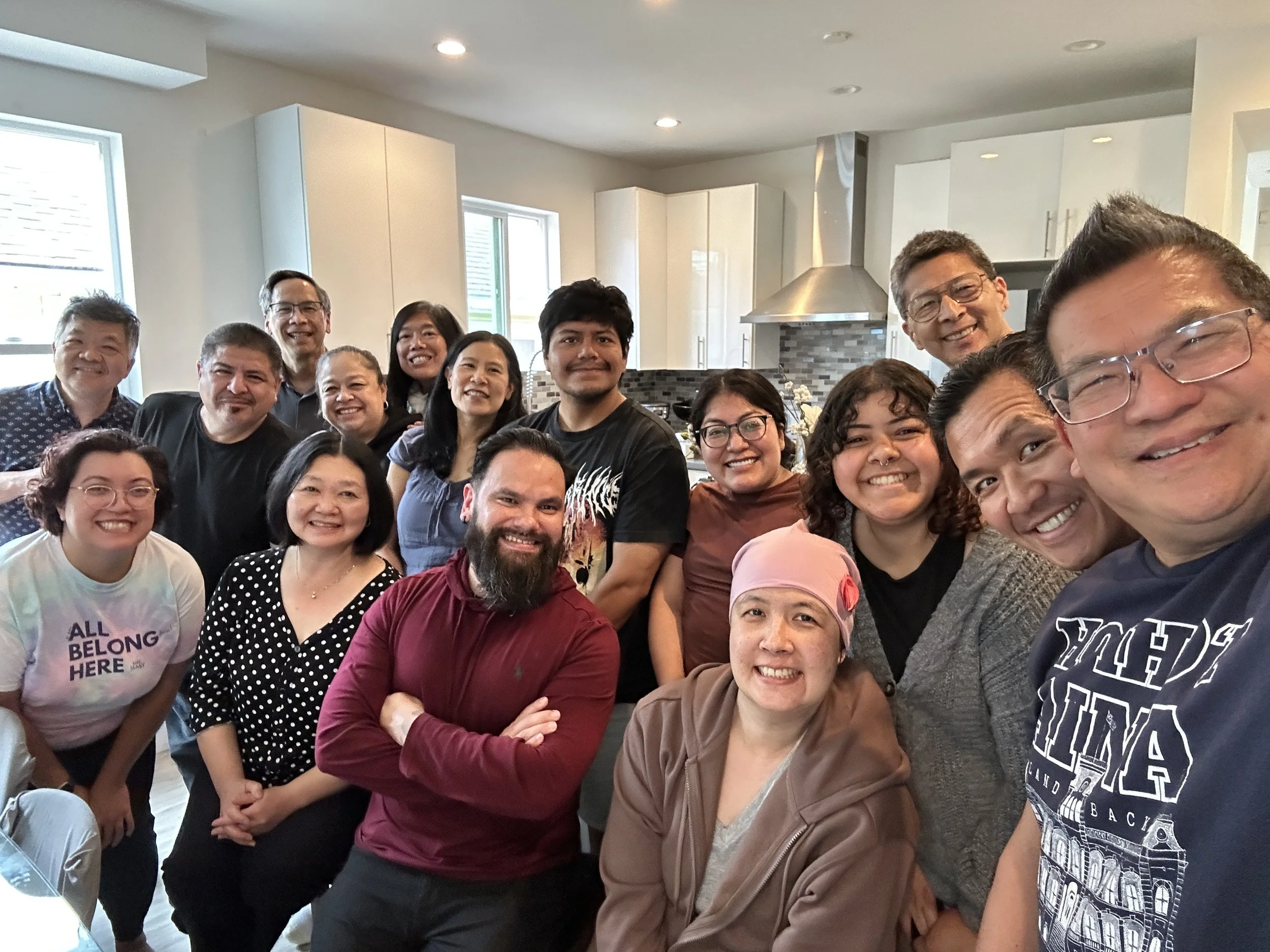
Retreat attendees together, author Neal is behind Craig Wong on right of photograph.
Our gathering is a testament and a living testimony of resilience and courage to articulate faith and to not be hijacked or defined by terms that are foreign to or contradict our experiences and perspectives as communities of color.
Gathering as we did on Juneteenth was intentional. Following the retreat, some of us walked two miles to a Filipino American Church of the Nazarene in Daly City to analyze the implications of Juneteenth, in conversation with African American leaders who serve in church and the corporate world. Through a panel discussion, representatives of our three communities of color – Asian American, Latinx American, African American – shared testimonies of how they came to integrate their Christian faith and ancestral heritage, and the struggles in doing so, particularly in White spaces. They shared their respective journeys in education, raising families, recognition from their church communities, and their own discovery of their sense of selfhood.
The month prior, I was in Juneau, Alaska as a new board director of New York-based Auburn Theological Seminary. Board members went to Alaska as part of Auburn’s initiative on narrative and storytelling. We wanted to participate in Alaska’s biennial “Celebration,” a festival of native Alaskans where storytelling and the sharing of indigenous Alaska heritage is on full display so that all generations can internalize the robust richness of common, diverse ancestry. Connecting that experience with the Juneteenth retreat, I came away from that monthlong engagement with deep gladness, joy, and gratitude for the value and power of gathering. Gathering is both for celebration, but also to share in collective trauma, and therefore of collective healing. Whether it be native Alaskans supporting each other in surviving the horrors of colonial abuse, to Asian American and Latinx American pastors sharing of how they were maltreated and ignored by White counterparts and colleagues, or African American leaders testifying of having to codeswitch in their communications so as to survive and thrive in spaces that question their credibility and integrity in occupying those same spaces, the power of gathering is to empower and co-inspire one another in the struggle.
One of the gifts given and received in Alaska was a book, Spirit Wheel: Meditations from an Indigenous Elder (Broadleaf 2023). It was written by Steven Charleston of the Choctaw Nation, and who was formerly Episcopal bishop of Alaska, and previously president and dean of the Episcopal Divinity School and professor of systematic theology at Luther Seminary. Charleston wrote this, titled “To Turn the Wheel of History” :
To each generation a task is given
By a will and purpose greater than our own
A work to be accomplished,
Even without knowing the outcome.
We are called, as if by an instinct of migration
Something deep in our collective subconscious,
A summons to see the moment clearly
To understand the implications, and then to respond
To act in order to change, to turn the wheel of history,
To save what must be preserved.
Now is our time. This is our calling.
We see the need. We know the consequences.
Let us be about what must be done.
Amen. May it be so.